Behavioral Reconstruction
A structured twelve-week process for changing one recurring pattern—and practicing a different response where it matters.
A free, 30-minute conversation to determine whether the work fits what you want to change.
The Situation
Your life probably works.
On paper. To other people. Most days.
You handle responsibility. You perform. You adapt. You produce.
And yet there is likely at least one area of your life where the same pattern keeps returning:
The conversation you avoid.
The decision you delay.
The responsibility you take back.
The need you leave unspoken.
The preparation that never becomes action.
Patterns like these don’t get worse loudly. They cost quietly. A year of returning to the same conversation. Another year of postponing the decision you already know. The opportunity that closed while you were still preparing. The cost compounds in the background, in years.
You understand the pattern intellectually.
But understanding it has not changed it.
That is where this work begins.
What Behavioral Reconstruction Is
Behavioral Reconstruction is a structured process designed to interrupt deeply embedded behavioral patterns and replace them with new behaviors that can survive contact with real life.
The work focuses on the gap between:
What you know.
What you say you want.
What your behavior continues to produce.
The body activates before the mind decides.
You may notice your stomach tighten, your attention shift, or an explanation begin before you recognize the familiar choice you’re making.
We examine that sequence, including what the response protects. Then we practice interrupting it and building what replaces it.
The Starting Point
Before beginning, you must be willing to examine one question honestly:
“How have I contributed to this situation?”
Not strategically. Not intellectually. Not performatively.
Honestly.
Taking responsibility for your contribution does not mean assuming responsibility for everything that happened. It means identifying where your choices give you something to work with.
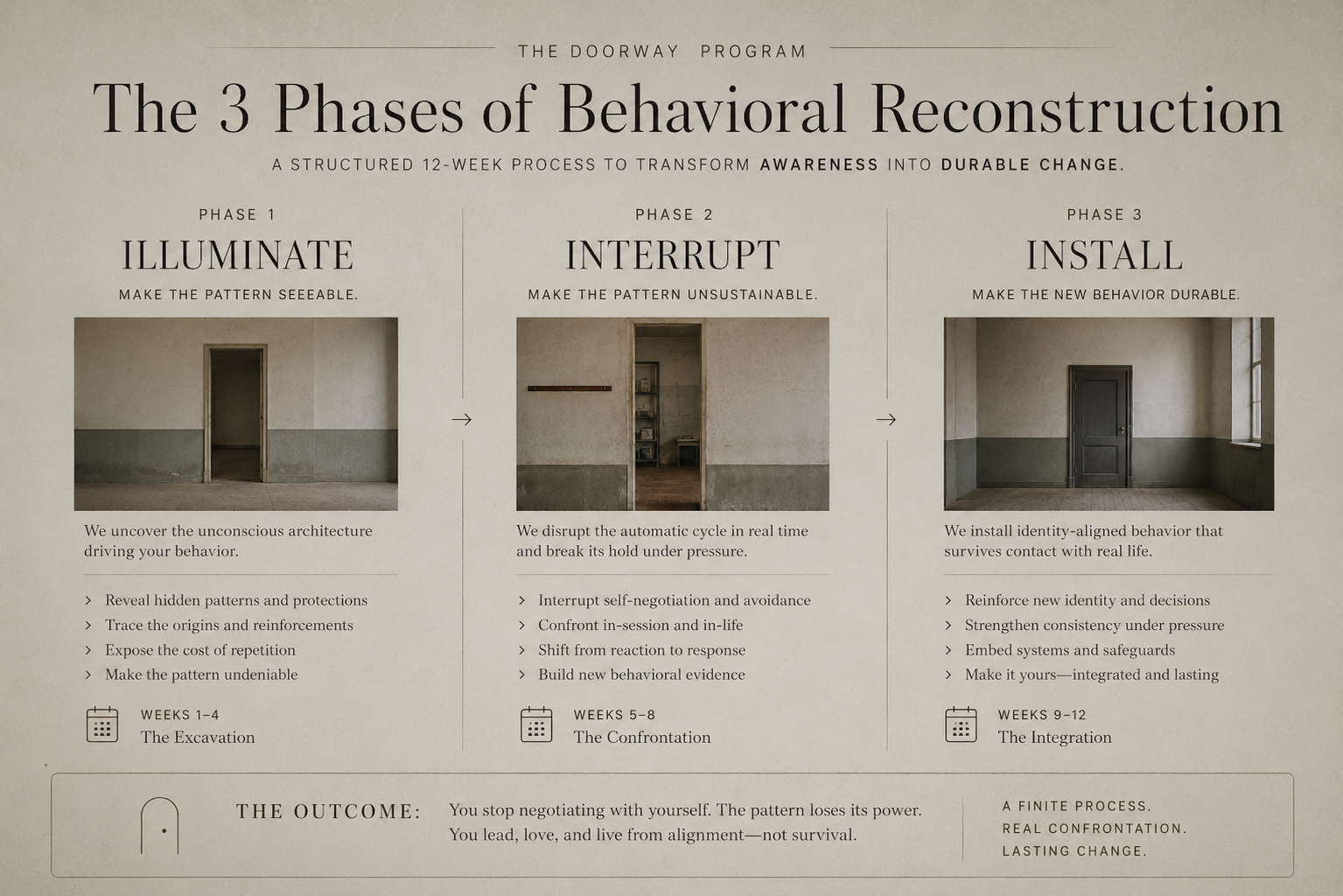
The Structure
The process unfolds across three phases.
Phase 1 · Illumination
Make the Pattern Seeable
Weeks 1–4 focus on identifying the structure beneath the visible problem.
You examine:
The repeating behavioral pattern.
The internal negotiation maintaining it.
The function it serves.
The experiences and beliefs you associate with it.
The concrete cost of remaining inside it.
By the end of this phase, the aim is to make the pattern visible, specific, and recognizable as it happens.
Phase 2 · Interruption
Disrupt the Familiar Response
Weeks 5–8 focus on interrupting the pattern while it is happening.
The work includes recognizing physical signals, examining familiar justifications, and practicing a different response when discomfort appears.
This phase is direct and confrontational by design. You examine the explanations that keep letting the same behavior pass.
The aim is to create room for a choice at the point where you usually repeat the pattern.
Phase 3 · Installation
Make the New Behavior Durable Under Load
Weeks 9–12 focus on deliberately practicing and testing what replaces the old response.
This phase includes:
Defining specific alternative behaviors.
Practicing them in daily life.
Reviewing follow-through.
Testing responses under realistic pressure.
Establishing practices for recognizing and responding to drift.
The goal is a behavioral shift that remains usable when you’re tired, uncertain, or challenged.
The Method
The work combines:
Direct, confrontational inquiry.
Behavioral observation.
Body awareness.
Emotional pattern recognition.
Guided meditation and experiential exercises.
Accountability.
Real-world implementation.
Many people arrive after years spent in environments where very few people challenge them honestly anymore.
This work does.
Your interpretations are examined. So are mine. You can disagree, question an exercise, or ask to pause.
The delivery, feedback, and accountability vary by format.
The Breakthrough Work
The guided Breakthrough experience in Phase 1 anchors the work that follows. It uses physical sensations and guided imagery to explore the experiences and beliefs you associate with a recurring pattern.
You examine what comes up, distinguish the experience from the meaning you gave it, and consider how that meaning shapes your behavior today.
You do not need to produce a particular memory or force an emotional response. Further work in Phases 2 and 3 builds on this foundation. The format determines how the experience is delivered.
Mirror participants work with a recorded guided meditation. Team and Doorway participants experience it with live facilitation.
What the work looks like
Suppose you keep postponing a difficult conversation. You know it needs to happen, but each time the opportunity appears, you find a reason to wait.
You examine a recent example. What happened just before you delayed? What did you notice physically? What did you tell yourself? What did postponing protect you from, and what did it cost?
You define a specific interruption and the action you will take. You practice that response and undertake the conversation. Then you review what happened: where you followed through, where the familiar response returned, and what needs adjusting.
Progress is measured in what you do differently when the situation appears again.
What Changes
The work focuses on one significant pattern and a behavioral standard you can assess through actual situations.
That might mean:
You leave a delegated project with your team.
You have the conversation before resentment builds.
You keep the appointment you would usually cancel.
You put your work in front of someone before you feel ready.
You ask for what you need and allow the other person to answer.
You also establish practices for continuing when the twelve weeks end.
What the Work Requires
A willingness to examine your contribution, undertake the practice, and report honestly on what happened.
Some of it may be uncomfortable. You can raise concerns, question an interpretation, or ask to pause. Discomfort alone does not establish progress.
This is behavioral advisory, not mental-health treatment. Suitability is part of the fit conversation.
Three ways to do the work.
The Mirror
Written structure. Self-directed practice.
Twelve weeks of sequential written work, with lifetime access. You undertake the inquiry, tracking, and practice independently.
- Format
- Written letters
- Duration
- 12 weeks + lifetime access
- Observation
- You observe yourself
- Accountability
- Self-managed
- Pace
- Yours
- Fit
- You do your best work alone
- Investment
- $1,497
The Team
Facilitated work. Peer witness. Shared accountability.
A closed cohort of six, meeting across twelve weeks, with a private hour in Week 6.
- Format
- 2-hr group sessions + 1 private hour in Week 6
- Duration
- 12 weeks, cohort closes
- Observation
- The group observes each other, Travis observes at midpoint
- Accountability
- Peer-provided + Travis check-in at Week 6
- Pace
- Cohort cadence
- Fit
- You need peer witness
- Investment
- Charter Cohort: $1,200 / Regular: $4,997
The Doorway
Private attention. Direct challenge. Individual accountability.
Twelve weeks of one-to-one advisory, with ongoing feedback and support for your between-session practice.
- Format
- Private 1:1
- Duration
- 12 weeks, container closes
- Observation
- Travis observes and challenges you
- Accountability
- Travis-provided (texts, midweek calls)
- Pace
- Sequenced to your arc
- Fit
- You need direct challenge
- Investment
- Charter price: $8,497 / Standard: $13,497
swipe to scroll