The Doorway Program
PRIVATE, STRUCTURED BEHAVIORAL WORK FOR PEOPLE WHO ALREADY UNDERSTAND THEIR PATTERNS AND CAN'T RELIABLY INTERRUPT THEM.
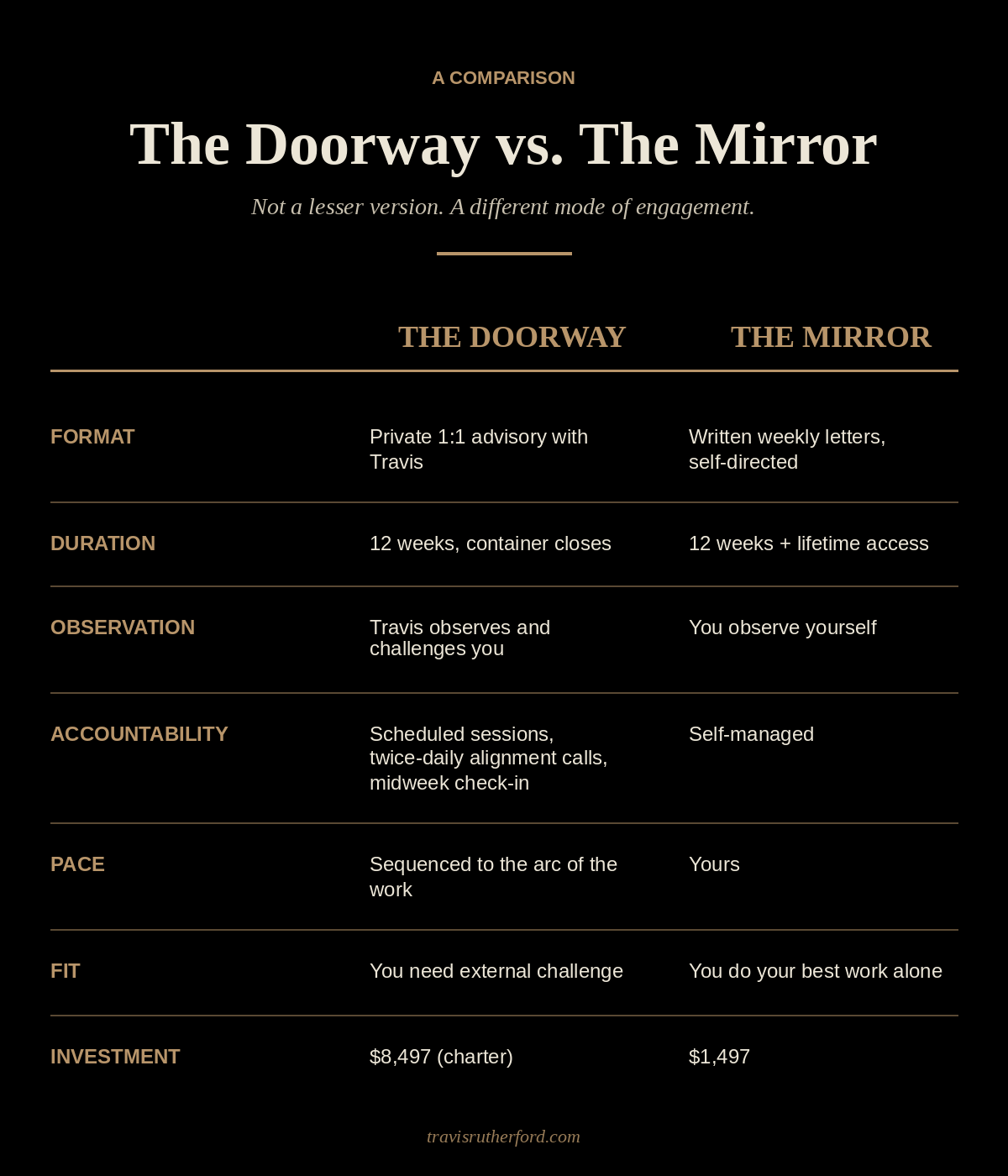
Twelve weeks. Private, one-on-one. Current charter fee: $8,497.
A free, 30-minute conversation to determine whether the work fits what you want to change.
My Commitment to You
In twelve weeks, you’ll change how you respond to one pattern you came in with, or I’ll give you another four weeks on me, provided you’ve done the work we agreed to and haven’t met the behavioral standard we set together.
The Situation
Your life probably works.
On paper. To other people. Most days.
You handle responsibility. You perform. You adapt. You produce.
And yet there is likely at least one area of your life where the same pattern keeps returning:
the relationship
the avoidance
the delay
the conflict
the collapse
the self-negotiation
Patterns like these don't get worse loudly. They cost quietly. A year of returning to the same conversation. Another year of postponing the decision you already know. The relationship that becomes harder to leave because you've stayed too long. The opportunity that closed while you were still preparing. The cost compounds in the background, in years.
You understand the pattern intellectually.
But understanding it has not changed it.
That is where this work begins.
What The Doorway Is
The Doorway is a structured 12-week process designed to interrupt deeply embedded behavioral patterns and replace them with new embodied behaviors that can survive contact with real life.
This work focuses on the gap between:
what you know
what you say you want
and what your behavior continues to produce
Because insight alone rarely changes behavior.
The body activates before the mind decides.
The nervous system locks in before the conscious story catches up. And most people attempt to install new behaviors before dismantling the structures maintaining the old ones.
The result is temporary insight followed by repetition.
The Doorway is designed to break that cycle.
The Entry Standard
Not everyone is ready for this work.
Before entering the process, a client must be willing to answer one question honestly:
"How have I contributed to this situation?"
Not strategically. Not intellectually. Not performatively.
Honestly.
Most clients arrive at a point where they are no longer frustrated with their circumstances.
They are frustrated with themselves.
Specifically: with the gap between what they know and how they continue to live.
That gap is where the work begins.
The Structure
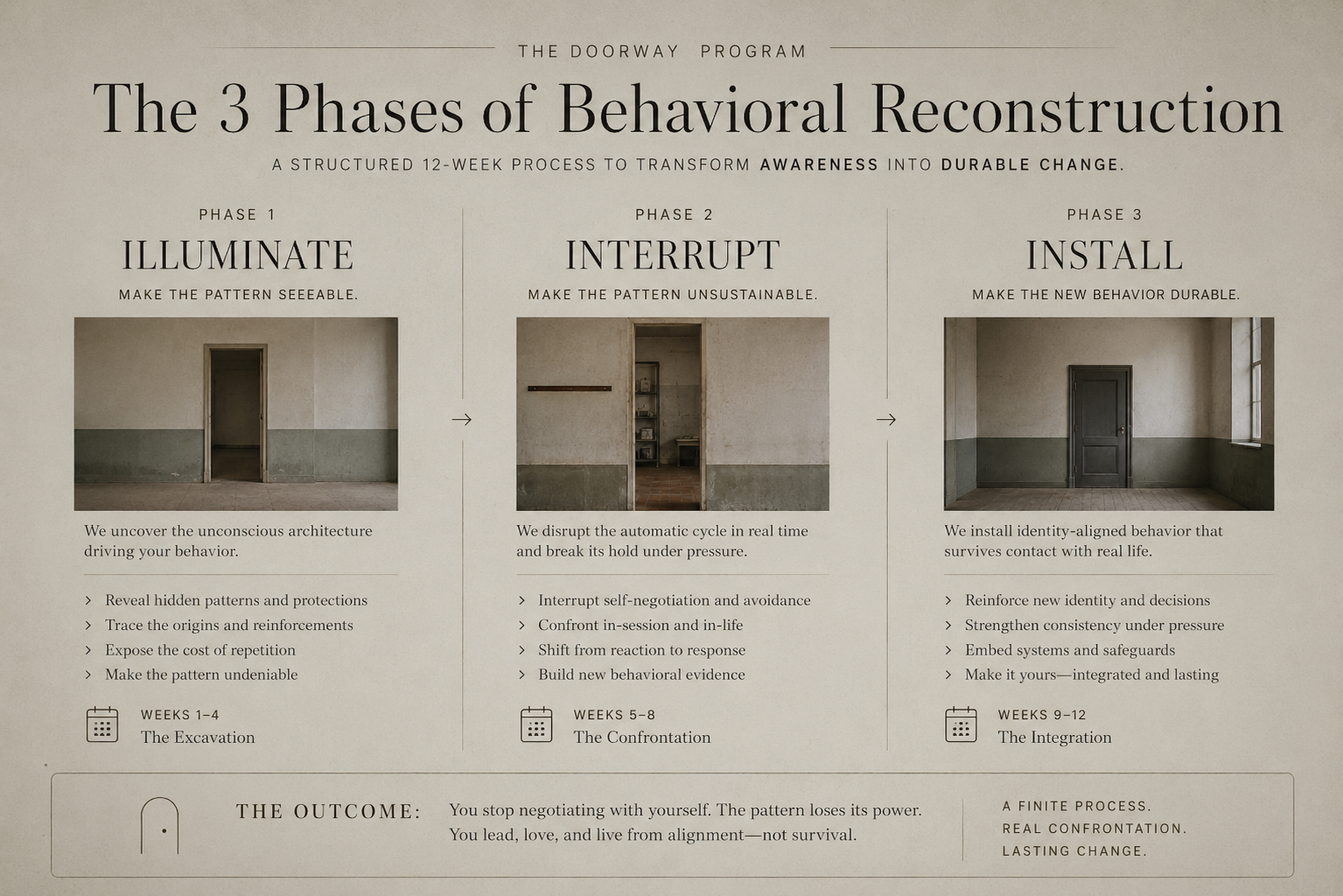
The process unfolds across three phases.
Phase 1 · Illumination
Make the Pattern Seeable
Weeks 1–4 focus on identifying the structure beneath the visible problem.
Together, we identify:
the repeating behavioral pattern
the internal negotiation maintaining it
the original adaptive function it once served
the first identity-level decision connected to it
the concrete cost of remaining inside it
By the end of Phase 1, the pattern becomes visible, specific, and difficult to continue ignoring.
Phase 2 · Interruption
Make the Pattern Unsustainable
This phase interrupts the pattern at the embodied level before the behavior fully locks in.
This work includes:
somatic mapping
nervous system awareness
confrontation in real time
emotional completion work
interruption of avoidance patterns
silence and void work
This phase is direct and confrontational by design. Not performative. Not theatrical.
The goal is not catharsis.
The goal is making the old structure impossible to continue unconsciously.
Phase 3 · Installation
Make the New Structure Durable Under Load
Once the old pattern loses structural integrity, new behavior must be deliberately installed and tested under pressure before the process closes.
This phase focuses on:
behavioral reconstruction
trigger interruption
decision architecture
embodied declaration
accountability structures
stress-testing under real-life conditions
The goal is not temporary emotional relief.
The goal is a durable behavioral shift capable of surviving contact with real life.
The Method
The work combines:
confrontational inquiry
Socratic dialogue
somatic awareness
behavioral observation
emotional pattern recognition
experiential exercises
accountability
real-world implementation
Many clients arrive after years spent in environments where very few people challenge them honestly anymore.
This work does.
Because avoidance survives in the spaces nobody is willing to name directly.
What the work looks like
Suppose you keep postponing a difficult conversation. You know it needs to happen, but each time the opportunity appears, you find a reason to wait.
We examine a recent example. What happened just before you delayed? What did you notice physically? What did you tell yourself? What did postponing protect you from, and what did it cost?
Together, we define a specific interruption and the action you will take. You practice that response and undertake the conversation. Then we review what happened: where you followed through, where the familiar response returned, and what needs adjusting.
Progress is measured in what you do differently when the situation appears again.
Who This Isn't For
This work is probably not a fit if:
you are looking for reassurance, motivation, or optimization strategies
you want insight without behavioral change
you are unwilling to tolerate discomfort or confrontation
you are primarily focused on managing perception
you are not willing to take responsibility for what becomes clear
The process only works when honesty becomes more important than protecting the existing structure.
The Commitment
The Doorway includes:
Twelve weekly ninety-minute private sessions, including the guided Breakthrough Session in Phase 1.
mid-week 15-minute check-ins between primary sessions
twice-daily 5-minute alignment calls
daily accountability and implementation work
direct behavioral follow-through expectations
Duration: 12 weeks
Investment: $8,497 (charter)
Format: Private, high-accountability advisory
Availability: Limited availability. Entry begins with a Calibration Call.
Charter pricing for the next three clients, in exchange for a written review at completion. Sticker returns to $13,497 after.
My commitment to you:
In twelve weeks, you’ll change how you respond to one pattern you came in with, or I’ll give you another four weeks on me, provided you’ve done the work we agreed to and haven’t met the behavioral standard we set together.
The Breakthrough session:
A 90-minute private session in Phase 1 that anchors the work that follows. I guide a meditation adapted to you, using physical sensations as a starting point to explore the experiences and beliefs you associate with a recurring pattern.
Together, we examine what comes up, distinguish the experience from the meaning you gave it, and consider how that meaning shapes your behavior today. You do not need to produce a particular memory or force an emotional response. We can pause or stop the exercise at any point.
Further guided meditations in Phases 2 and 3 build on this foundation.
The Outcome
Phase 1 makes the pattern seeable.
Phase 2 makes it unsustainable.
Phase 3 makes the new behavior durable under load.
What the program is designed to produce:
one major behavioral pattern interrupted
measurable reduction in internal self-negotiation
stronger self-trust
closer congruence between values and action
practices designed to sustain the work without dependency
What that can look like:
You stop returning to relationships you already know are over.
You stop organizing your schedule around emotional avoidance.
You stop collapsing into distraction the moment discomfort appears.
You become capable of making decisions without requiring emotional certainty first.
This is not about becoming someone new.
It is about becoming unable to continue betraying what you already know.
The Calibration Call exists to determine:
whether the work is appropriate
whether the timing is right
whether genuine readiness exists for this level of confrontation and change
Not everyone is a fit. And that is intentional.